How AI Chatbots Improve Website Conversion Rates in E-Commerce
Selling online has never been more competitive. Customers today have options — endless options — and if your website makes them work even slightly too hard to find what they need, they’re gone. That’s the reality most e-commerce businesses are navigating right now, and it’s exactly why AI chatbots have gone from a “nice to have” to something businesses genuinely can’t afford to ignore.
From real-time answers to recommendations that actually make sense for the individual visitor, chatbot technology is reshaping how brands connect with customers and close sales. Whether you run an e-commerce website, a service-based platform, or a lead generation business, understanding how AI chatbots improve customer journeys can give you a major advantage. This piece breaks down the top ways AI-powered tools help businesses increase conversion rate, sharpen the sales funnel, and build digital experiences that visitors actually enjoy.
1. Why Are AI Chatbots Becoming Essential for Conversion?
Here’s something most businesses don’t think about enough: the moment a visitor can’t find what they’re looking for, you’ve already lost them. They don’t email you. They don’t wait. They just leave.
The modern customer expects instant answers, fast navigation, and personalised experiences. Traditional websites often fail here because users are left to search through pages, wait on replies, or hunt for basic information themselves — all of which creates friction that chips away at conversion.
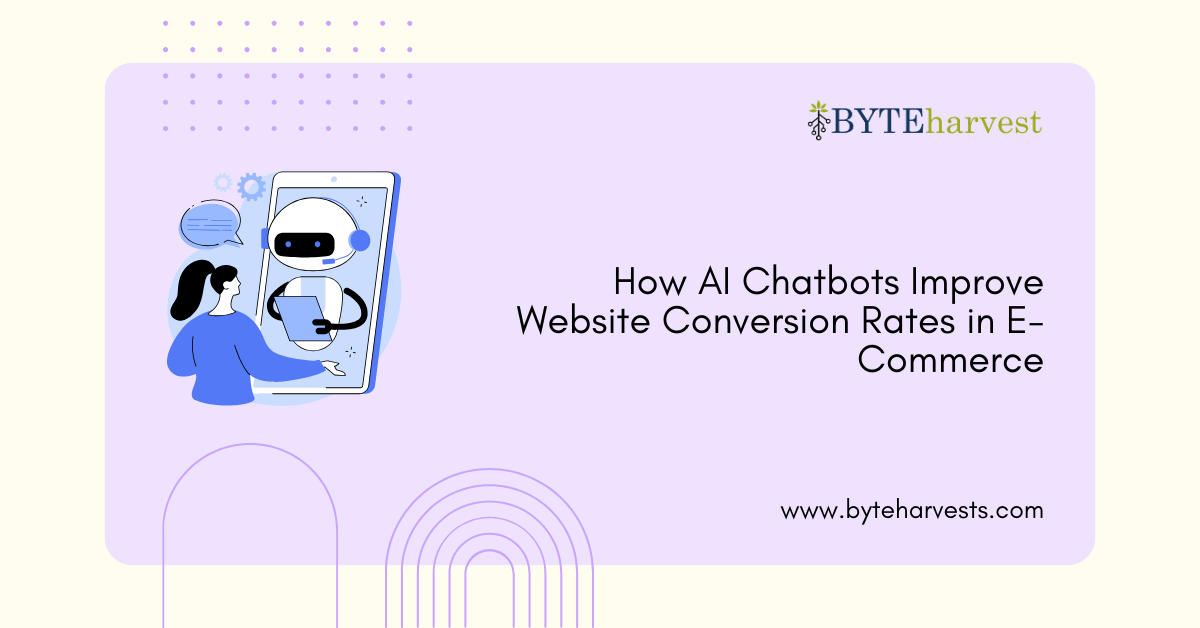
That’s where ai chatbots change things. A well-built chatbot works like a knowledgeable assistant available at any hour — one that responds to every query instantly rather than making customers dig for answers on their own.
Businesses increasingly use AI because it lets websites run 24/7 while handling customers at real scale. These tools analyze user behaviour, surface relevant products, and walk people toward a purchase decision — all without needing a human on the other end. The result is better engagement and stronger conversions across the board.
2. How Do AI Chatbots Improve Website Conversion Rates?
Most visitors who leave without buying didn’t dislike what you were selling. Something got in the way — an unanswered question, a price buried three clicks deep, an uncertainty they couldn’t shake.
That hesitation is exactly what ai chatbots are built to remove. When a visitor has customer queries about shipping times, return policies, or product specs, a chatbot answers immediately — no ticket, no wait, no friction. That speed builds trust fast, and trust converts.
Personalization plays an equally big role. AI systems don’t treat every visitor the same. They read browsing patterns, factor in past purchases, and tailor conversations to the individual. When someone feels like the website actually understands what they’re looking for, they stick around longer — and that directly drives stronger website conversion rates.
Businesses that roll out AI tools also see conversion rate optimization benefits that compound over time: lower bounce rates, longer sessions, and more visitors reaching checkout.
3. Can AI Chatbots Personalize the Customer Journey?
Nobody wants to be just another anonymous visitor. When a website responds to your actual interests — not some generic template — the whole experience shifts. It feels deliberate, and that feeling keeps people engaged.
Personalization is one of the sharpest advantages an ai chatbot brings. Rather than showing everyone the same content, AI-powered systems adjust product suggestions, messaging, and offers based on what each user has browsed, searched, or bought before.
An e-commerce chatbot, for example, can pick up on a user’s browsing history and recommend products that genuinely fit — not just what happens to be on sale. That kind of relevance smooths out the customer journey and improves customer satisfaction in ways that generic product pages simply can’t.
The downstream effect matters too. Users who feel understood come back. They trust the brand. And that trust — built through smart, personalised chatbot conversations — has a direct impact on both conversion and long-term loyalty.
4. What Role Do Chatbots Play in the Sales Funnel?
Every visitor arrives at a different stage of readiness. Some are just exploring. Others are actively comparing options. A few are one good reason away from hitting “buy.” The problem is that most websites treat all of them the same way.
A chatbot on your website can meet each visitor where they actually are. In the awareness stage, it answers broad questions and offers useful context. During consideration, it compares options and highlights what makes your product the right fit. When someone’s close to a decision, it can offer an incentive — a discount, a guarantee, a nudge — that pushes them over the line.
That kind of tailored guidance creates stronger conversions with AI by reducing the uncertainty that kills so many potential sales before they happen.
5. How AI Chatbots Help Customer Support Teams?
Think about the last time you reached out to a company’s support team and waited half a day for a reply. That wait has a cost — and it’s not just your patience. For businesses, delayed responses mean abandoned carts, lost sales, and customers who don’t come back.
AI-powered chatbots cut that delay to zero. Customer queries about refunds, availability, shipping, or pricing get answered in seconds — any time of day, including hours when your human team isn’t around.
The smart approach isn’t chatbots instead of people — it’s chatbots alongside people. Let the AI handle the repetitive, high-volume customer interaction, while your support staff focuses on the nuanced conversations that genuinely need a human. Everyone wins: efficiency goes up, response times drop, and customer satisfaction follows.
The scalability piece shouldn’t be overlooked either. A chatbot can handle thousands of simultaneous conversations without breaking a sweat. That’s something no human team can match.
6. Why Are AI Chatbots Important for E-Commerce Websites?
E-commerce is unforgiving in a way that physical retail isn’t. A confused customer in a store can ask someone nearby for help. A confused customer on your website just closes the tab.
Speed, convenience, and clarity are the pillars of a strong e-commerce experience — and when any one of them slips, cart abandonment follows. AI chatbots boost online sales by staying with customers through the entire shopping journey, from first browse to final checkout.
They can surface trending products, drop in a discount code at the right moment, suggest items that complement what’s already in the cart. That’s upselling and cross-selling happening naturally, without being pushy. And when something goes wrong during checkout — a payment question, a promo code that won’t apply — real time support means the customer gets unstuck instead of giving up.
Businesses that implement chatbots tend to see this in their numbers: higher conversion rates, better retention, fewer abandoned carts.
7. What Are the Best Use Cases for AI Chatbots?
The flexibility of chatbot technology is honestly one of its most underrated qualities. There’s no single type of business that benefits — the applications stretch much further than most people assume.
Lead generation is one of the most common. Instead of waiting for a prospect to fill out a form, chatbots qualify leads in real conversation — collecting contact details and understanding intent before handing off to a sales team.
Service businesses use them for appointment booking, letting customers schedule directly through a chat window without anyone picking up a phone. Retail brands use AI chatbots to deliver product recommendations and promotions tailored to individual behavior. Educational platforms guide students through course options. Healthcare businesses answer preliminary questions and route patients to the right consultations.
The thread connecting all of these? Chatbots help businesses across industries get more from every visitor interaction.
8. How Do AI Chatbots Improve Website Engagement?
Most websites are passive. They sit there and wait for visitors to find what they need. Chatbots flip that entirely — they reach out, start conversations, and pull people deeper into the experience rather than hoping they’ll stay.
AI-driven chatbots improve website engagement by being proactive. A visitor lands on a product page — the chatbot greets them, asks what they’re looking for, and points them somewhere useful. That kind of initiative keeps people on the site who would otherwise have clicked away in under a minute.
The conversations themselves matter too. Conversational AI has gotten good enough that interactions feel natural rather than robotic. And natural conversations build emotional connection — the kind that translates into clicks, time on site, and return visits.
As more businesses invest in AI, the gap between sites with chatbots and those without is showing up clearly in engagement metrics.
9. Are AI Chatbots Better Than Traditional Customer Service?
This isn’t really a competition — the businesses seeing the best results aren’t choosing one over the other. But in terms of raw speed, availability, and consistency, chatbots do things traditional support structures can’t.
Traditional support means limited hours, queues, and responses that vary depending on which agent picks up the ticket. AI chatbots provide immediate, accurate assistance at any hour, with no variation in quality.
What’s changed is how intelligent these systems have become. Modern AI doesn’t just respond to keywords — it learns from interactions, gets better over time, and adapts to shifting user behavior. When something genuinely complex comes up, it escalates to a human agent. That hybrid model gives businesses the best of both: automation at scale, human judgment where it counts.
The businesses leaning into this combination are seeing real gains in customer satisfaction, efficiency, and retention.
10. What Should Businesses Consider When Implementing AI Chatbots?
Jumping into chatbot implementation without a plan is where a lot of businesses stumble. A poorly designed chatbot — one that gives robotic answers, misreads intent, or clashes with your brand voice — can do more damage than having no chatbot at all.
Start by getting clear on what you actually need. Is this about lead generation? Reducing support load? Improving checkout completion rates? The goal shapes every decision that follows.
Once the objective is clear, focus on conversation design. The chatbot needs to sound like your brand — not like a generic AI. And it needs to connect with your CRM tools, analytics platforms, and customer databases to do anything truly useful.
Build in measurement from day one. Track chatbot conversion rate, engagement data, and customer behavior. The businesses that iterate based on real data are the ones whose chatbot performance keeps improving.
Key Takeaways:
- AI chatbots help businesses improve conversion through faster communication and personalization.
- A chatbot reduces friction by answering customer queries instantly.
- Personalized recommendations improve customer engagement and online sales.
- Chatbots support every stage of the sales funnel.
- AI-powered systems provide real time support 24/7.
- Ecommerce businesses use chatbots to guide users during purchases.
- Chatbots improve user experience and reduce bounce rates.
- Businesses can integrate chatbot systems with CRM and analytics tools.
- Advanced AI chatbots can handle complex interactions more efficiently.
- Companies that use AI strategically achieve stronger website conversion rates and customer satisfaction.